The Final Report
Housed, But Homeless: Social Belonging and Locational Viability in Helsinki
A personal study on belonging, viability, and the realization that building community is not the same as building a home.

This experiment ultimately changed my research question. Rather than deciding where to live, I'll first redesign how I live—and let that determine whether Helsinki remains a viable option for me going forward.
01
At a glance: overview
I conducted a personal field study and experiment to evaluate whether I belonged in Finland and should continue building my life here. I approached belonging as something that could be observed, measured, and intentionally designed for.
Over the course of one month I tested events, apps, and activities and combined daily quantitative tracking with qualitative field notes to evaluate social belonging and overall locational viability across six dimensions: environmental fit, social resonance, reciprocity, community continuity, professional sustainability, and future potential. Rather than relying solely on instinct, I wanted to observe what my life actually looked and felt like—and to make important life decisions from evidence rather than inertia.
The experiment ultimately answered a different question than the one I expected. I found that I can intentionally build meaningful friendships, community, and a genuine sense of social belonging in Helsinki. What remained unresolved was not social belonging, but whether that belonging was anchored in a viable professional and domestic life -- in short, I found community-level solutions, but overlooked the importance of home.
While the data showed strong social continuity and positive community experiences, it also revealed persistent local professional challenges and the absence of a domestic life that felt supported, reciprocal, and sustainable. As a result, this report concludes not that Finland has failed me, nor that I have failed here, but rather that my current way of living is no longer sufficient. The decisions that follow therefore focus not simply on whether to stay or leave, but on redesigning how I live before deciding where I live.
| Value | |
|---|---|
| Period | 2026-06-02 → 2026-06-30 |
| Daily entries | 31 |
| Events logged | 29 |
| Events attended | 17 |
| Days of field notes | 30 |
The experiment at a glance.
02
Introduction
I don't believe in a passive life, but I noticed that I'd been living in a place for over a decade without conscious consideration as to whether this place was genuinely for me.
For context, I'd moved to Finland for a spouse whom I later divorced. Since that life change, however, I had never paused to reflect on whether the place I remained in remained a place I belonged. So, for me, this study is more than purely social curiosity; it's a conscious consideration of what I need and want from where I live at this point in my life.
As such, this is not a traditional research report.
The data and summary I'm walking through here are personal and structured around observed realities. The decisions I ultimately make and present in this report are informed by those observations—but they're ultimately guided by my feelings about that data.
To be clear, then, while I am treating certain life decisions as an empirical experiment, I'm not privileging quantitative input over experiential insight.
Whether the numbers and field notes referenced here show success or flag concern, I've considered their contexts and my emotional responses to what I've learned from them.
Thus, in this report, you'll find both facts and feelings—and it's from the consideration of both that I arrive at a path forward.
03
Approaching belonging: methodology
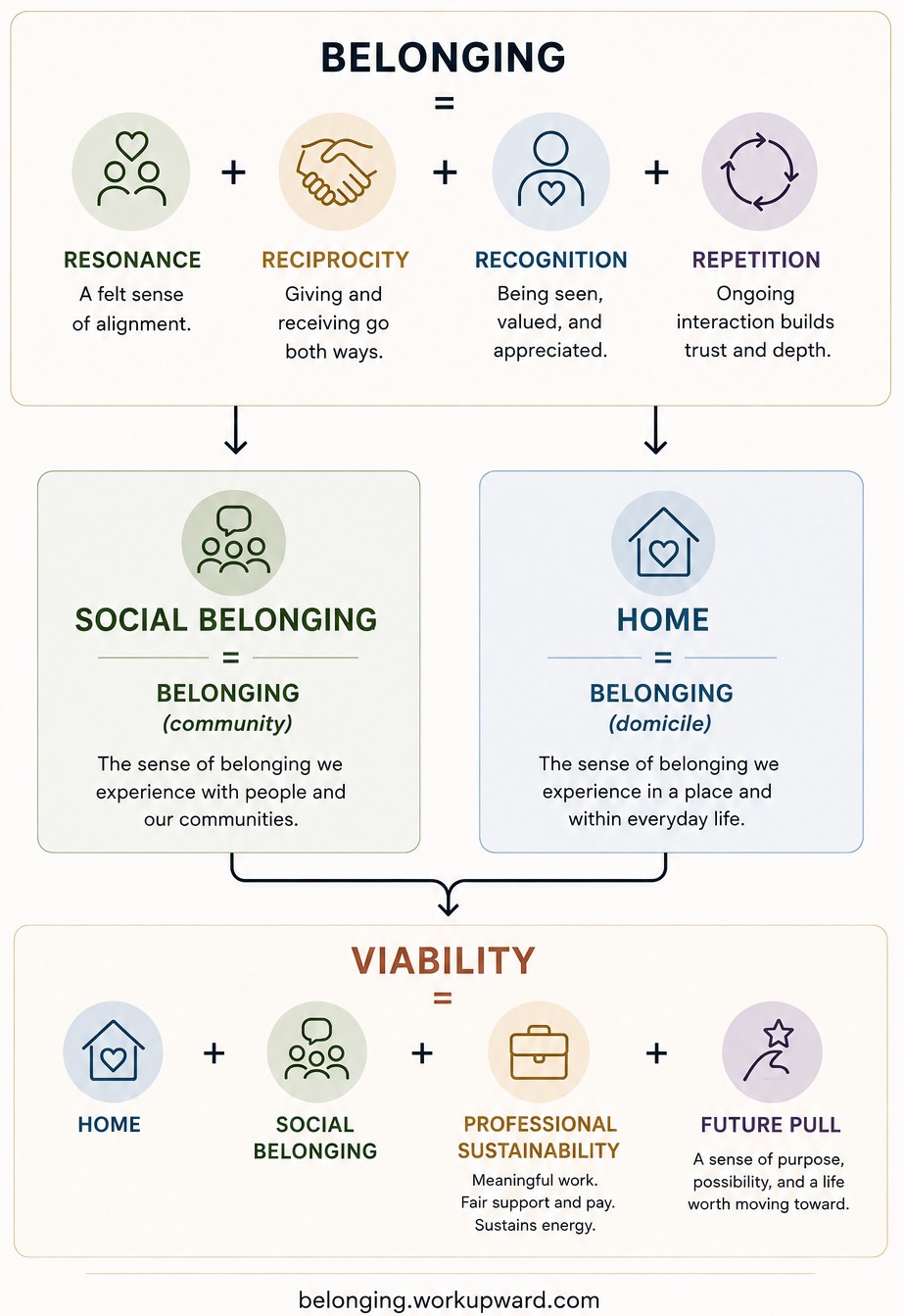
In this study, I define overall locational viability as the extent to which a particular place supports the construction of a life that is socially, professionally, emotionally, and environmentally sustainable over time.
Operationally, viability was measured not as a single feeling, but as the combined experience across six analytical lenses:
Ambient Effect: how the surrounding environment affects my wellbeing.
Social Resonance: the degree to which I experience authentic intellectual and emotional alignment with others.
Social Reciprocity: whether care, effort, and initiative flow in both directions.
Community Continuity: whether relationships persist beyond isolated encounters and become part of everyday life.
Professional Sustainability: whether I can realistically build a livelihood without compromising my values or identity.
Future Pull: whether living here creates excitement and possibility for the future.
Within that broader construct, social belonging refers specifically to the relational experience of resonance, reciprocity, recognition, and continuity.
In this framework, then, neither viability nor belonging would be synonymous with happiness nor even with general satisfaction. Rather, locational viability is the cumulative evidence that a place can support the life I'd currently want to live -- and social belonging refers to the relational evidence that I am actually recognized, reciprocally connected, and anchored within it.
To provide that evidence, between June 1 and July 1, 2026, I logged 31 daily entries, recorded 29 distinct events, and accumulated 30 days of qualitative field notes.
I tracked my life across the six analytical lenses, each with 5-6 sub-metrics (scored 1–5 scale daily). I also tracked five value areas (1–5 scale): Intellectual, Emotional, Physical, Communal, and Habitual -- for each interaction in a day, considering what each interaction provided to my life.
Additionally, I calculated Energy ROI for events (joy gained relative to effort spent, where a score > 1.0 indicates a net energy return), tracked interaction modes (in person, video, phone, messages, social media, email), and categorized interaction composition (close & recurrent, close & occasional, emerging associates, family, spontaneous acquaintances).
From this, I arrived at a picture of a place as I actually experienced it to consider whether that experience is, in fact, viable and supportive for me.
04
What the numbers said
The quantitative results from the experiment outline both my level of social belonging and the broader viability of my life in Helsinki.
Period Means Across Six Lenses (1–5 scale):
Period means for each lens, on the 1–5 scale used every day.
- Overall Viability Score: 3.66
- Overall Social Satisfaction: 3.74
Period Means Across Values Areas (1–5 scale):
Which parts of life the days actually fed, on average.
Energy Metrics:
Where the day's energy started and where it ended.
Average change across the day: +0.39.
Event Attendance and ROI:
| Count | Share | |
|---|---|---|
| Events logged | 29 | — |
| Actually attended | 17 | 59% |
| Would do again | 14 | 82% of attended |
| Created continuity | 12 | 71% of attended |
| Produced new contacts | 6 | 35% of attended |
| Met someone again | 14 | 82% of attended |
What the logged events amounted to.
In-Person vs. Remote Events (Attended):
| In person | Remote | |
|---|---|---|
| Events attended | 13 | 4 |
| Mean joy | 3.85 | 3.75 |
| Mean energy ROI | 2.01 | 3.38 |
| Created continuity | 9 | 3 |
| Produced new contacts | 4 | 2 |
Attended events compared: in person against everything remote.
Interaction Modes (194 total logged interactions):
How contact actually happened, as a share of all logged interactions.
Context Metrics:
- Went outside: 19 / 31 days (stayed indoors 12 days).
- Childcare presence: daughter fully present 10 days, partially present 12 days (absent 9 days).
Daily overall viability score; the dashed line is the period mean.
The numbers quantify a structural contradiction in my life here: the evidence suggests that I can build social belonging in Finland, as reflected in relatively strong community continuity, social resonance, reciprocity, and overall social satisfaction. It does not, however, establish that Finland currently supports an overall viable life for me across every dimension included in the study. Local professional sustainability, at 2.56, remained the clearest source of friction and pulled the overall viability score down to 3.66.
05
What the fIeld notes said
Beyond professional viability, the field notes showed a structural disparity between the effort I invest and the reciprocal anchoring I receive.
Broader context: The Historical Audit:
Not including board game nights or Thanksgiving dinners, in eleven years in my Finnish apartments, I've hosted 116 brunches, each with 3 to 7 guests (with an average of 50% new attendees for each). Through those engagements alone, I've welcomed between 250 and 500 unique individuals into my home. In that exact same 11-year period, I have been invited to the homes of 13 people -- and only 2 of them were exclusively Finnish.
Broader Context: Professional Reciprocity Deficit:
Last year, Finnish individuals and organizations filled 63% of my working hours (including pro bono sessions, ad-hoc advice, team clinics, brainstorming, and mentoring sessions). However, only 8% of my total revenue in that same period came from Finland.
Interaction Composition & Distance:
Throughout the entire observed month, 75% of my interactions were spontaneous or with new acquaintances as opposed to with on-going or well-established connections. My daily social diet relied heavily on remote messaging (52% of interactions) -- often with contacts abroad -- rather than in-person or local contacts.
Community vs. Home:
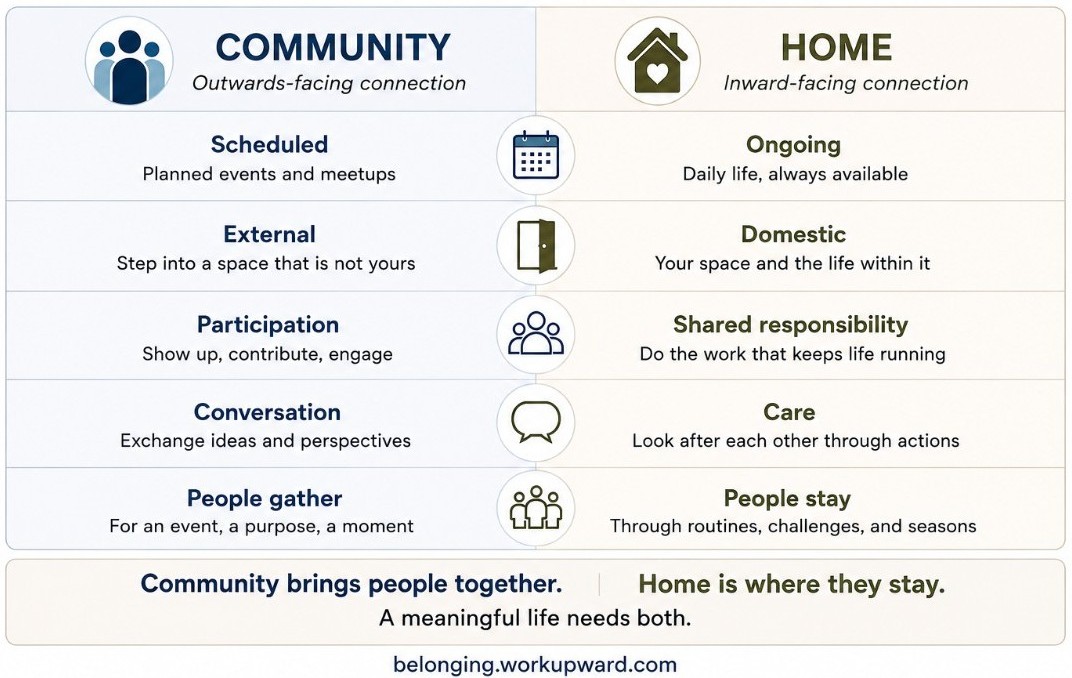
Events like UPWARD Meetups and being invited to a Midsummer BBQ in June demonstrated that I can experience social belonging in local community spaces . But when the cafe closes or grill cools off, people return to their domestic bases -- and I personally don't have a social domestic arrangement here myself. External interactions for me, then, are inherently imbalanced. For instance, on my part, my external interactions were socially essential, while for other, more locally anchored participants, the same interactions were socially supplementary. This dynamic affected and was especially apparent in the differences in availability, as experienced in the observed month: it proved challenging to schedule meaningful interactions on an impromptu basis or during later ("family") hours for domestically settled people -- the vast majority of people whom I interacted with.
06
Learnings: what worked & didn't
The experiment provided clear data on which social and professional strategies yielded positive returns for me in Helsinki, and which were structural dead ends for deepening social belonging (as I defined it).
What Worked:
- Friends of friends: Every high-value 1:1 conversation during the month came through warm recommendations rather than random serendipity. Pitch a Pal (www.pitchapal.com) proved a viable connection concept.
- Dog encounters: Dog owners in local parks happily talk to strangers and break through urban distance.
- Maximal public authenticity: Expressing ideas openly on social platforms acts as an efficient screening mechanism, attracting highly resonant individuals and repelling non-viable ones quickly.
- Small, niche, recurring gatherings: Events like the Outrun afterwork (8-20 attendees each) yielded high social satisfaction, meaningful intellectual dialogue, and prompted a lasting Signal group for continuity.
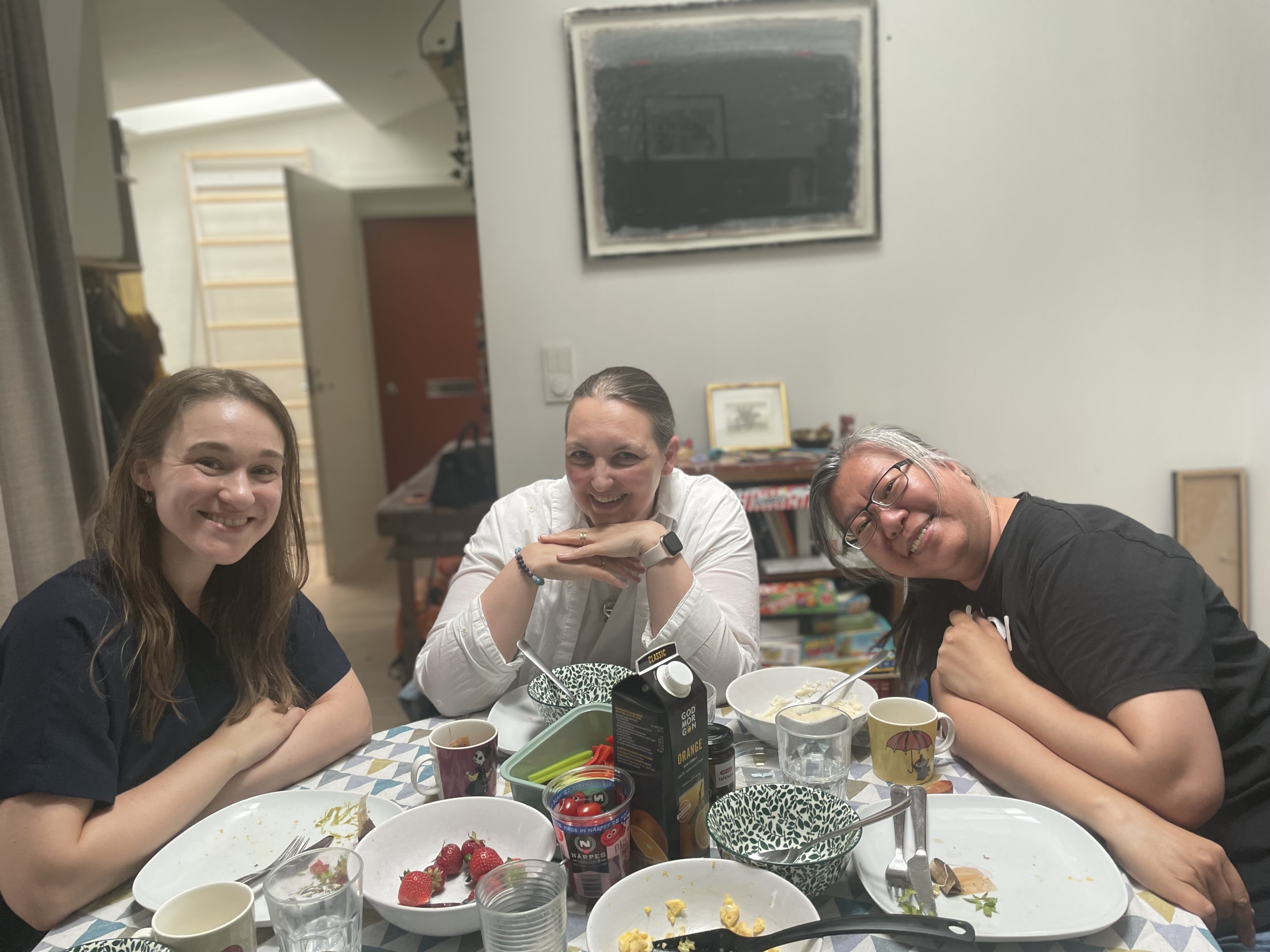
- Parent-child playdates: Connecting with parents whose children my daughter genuinely likes created immediate, low-friction communal continuity -- albeit of varying depth or quality, depending on compatibility with the parents themselves.
What Didn't Work:
- Large public events: Attending broad gatherings required massive initial energy loans, yielded low Energy ROI, and produced few lasting connections.
- Hobbies: Joining hobby groups yielded activity buddies rather than broadly resonant life connections, and demanded time and energy I do not consistently possess.
- Apps for friendships: Built around shallow prompts and irrelevant metrics and matching algorithms, most apps treated platonic connection as a consolation prize or a design add-on to searches for romantic connections.
- Municipality-sponsored social initiatives : Multiple Finnish municipalities have existing projects and external service partners in this area, most of which focused on building connections and community around shared circumstances (e.g., new arrivals, etc) or shared demographics (e.g., new parents, etc.), as opposed to compatible personality or alignment-based community co-construction.
In short, leaning into and leveraging one's individual and peculiar personal assets (e.g., unique personality, pre-existing connections, children, pets, etc.) to deepen and extend existing ties worked in support of recurring opportunities for continuity. As methods for building social belonging, artificial or personality-agnostic connection creation events, tools, or services rarely yielded more than introductions; sustained interest came less from activities than from curated conversations.
07
Considerations
So, there were quite a few efforts and undertakings that did, in fact, serve to build a sense of community and to improve an overall sense of social belonging. However, when reflecting on the data at the end of the observed month, there were additional considerations to weigh and some conflicting realities to acknowledge. For instance:
Communal Limitations
Community and belonging can be created, yes—but they're ultimately external connections and resources available (metaphorically) Monday-Friday during business hours. They're essential and can be intentionally constructed, but ultimately, they're not a replacement for having a home to return to when those external resources are unavailable. Home, then, may be a previously unacknowledged co-requisite of community and a sustainable life for me, even when social belonging is already present.
For me, I could theoretically build a version of home through co-creating an urban domestic community and/or co-housing arrangement with close friends to share meals, childcare, and domestic social enrichment—there might be some interest in that. However, a practical reality is that most of my favorite people are the least financially solvent ones I know, and under-employed or under-funded people cannot make long-term financial commitments to invest in or rent property or sustain domestic infrastructure.
Further, the risks for a shared home are higher than for a shared external community, and, as such, building a domestic arrangement with strangers presents very real safety and compatibility concerns for not just myself, but also for my daughter. That wouldn't be an option to be lightly chosen.
Possibly Incompatible Core Values
The dominant social norms I have encountered in Finland often prioritize independence, quiet, space, advanced planning, and strong self-sufficiency.
I, however, prioritize interconnectedness, communal resilience, shared presence, spontaneous interactions, and meaningful (though escapable) noise.
Practically, this potential incompatibility may limit Finland’s overall locational viability for me, even where social belonging is otherwise possible.
Network Limitations
I noticed that one of the most effective means for me to discover and extend social resonance in my network was through 1:1 introductions. I also noted that very few people (3% of the people I interacted with that month) in my network had ever actively shared connections with me or introduced me to other people.
In the networks I encountered, social circles appeared strongly siloed, and cross-context introductions seemed to be literally and metaphorically foreign.
Domestic Limitations
I currently own a flat in downtown Helsinki—a one-bedroom apartment best suited for one person or a couple. I share this flat with my daughter for half the week, and it's conveniently located a seven-minute walk from her school, which offers an English-language program (a rarity in Finland).
My flat is not large enough to add another person to it, so if I wanted to bring belonging into my home life and live with additional people, I would have to relocate.
(Note: If I were to relocate within Finland, it would still have to be within the Helsinki Metropolitan Area and close to to reliable connections to Stockholm, Copenhagen, Oslo, Tallinn, Frankfurt, and Berlin, where I have existing clients.)
Professional Realities
Beyond the demands of international commuting, I'd prefer to work in the same country I live in (a) to further local community and camaraderie and (b) so my country of residence and I could reciprocally invest in each other's futures.
I acknowledge that finding in-house employment in the current market would be challenging regardless of where I settle, and I note that entrepreneurship has significantly different economic and bureaucratic benefits and liabilities across countries.
This merits deeper consideration in future, and it may impact where and how I choose to work.
The Parental Dilemma
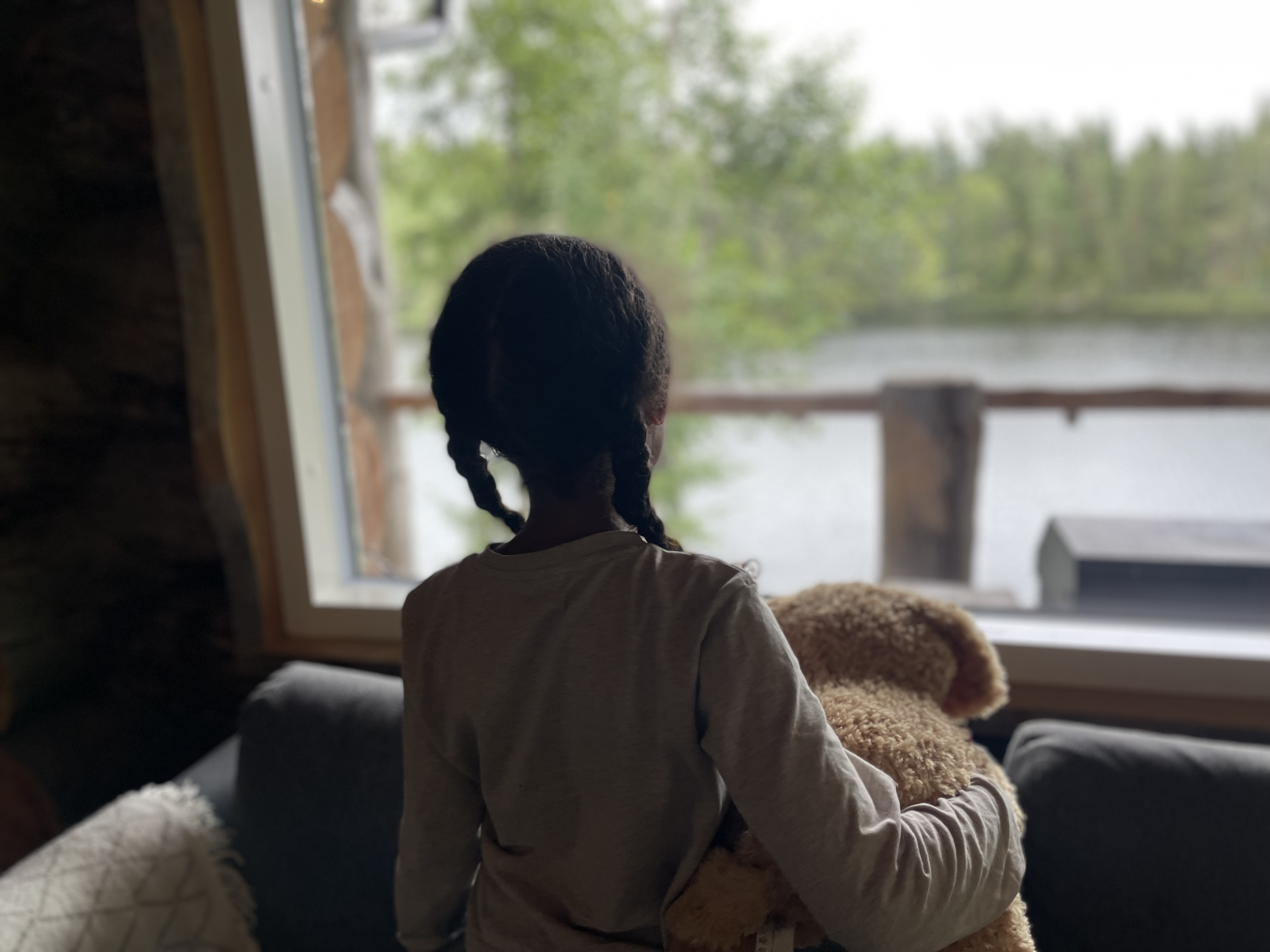
My daughter loves Finland, has family and friends here, feels safe, and wants to stay in this country.
But lacking consistent professional and domestic support for myself here, we are not both thriving in this place—and I cannot offer her my life in exchange for my presence.
While I can generate revenue from elsewhere, living here as a single parent without domestic community is essentially draining, and internal resources are finite.
International Relocation and its Challenges
As a potential source of domestic community, I have family and long-standing friendships abroad. However, an international move with my child would require her acclimating to a new country and culture while becoming more distant from what is currently her emotional home and more familiar family.
Moving without her would require significant logistical and emotional adjustments, effectively losing half of her parental presence and much of her social and academic support.
08
The decision(s)
The original question behind this experiment was whether I should stay in Finland.
After considering the quantitative data, the field notes, the historical context, and my own emotional response to what I observed, I do not think the most responsible answer is an immediate and uncomplicated yes or no.
What I can say with confidence is that the life I am currently living here is not sufficient—and that continuing it unchanged is no longer an acceptable option.
1. I will not maintain the status quo.
The experiment demonstrated that I can successfully build friendships, community, continuity, and a meaningful degree of social belonging in Helsinki.
That finding matters.
It also demonstrated that doing so does not, by itself, resolve certain structural deficits in my life here.
Local professional sustainability remains weak. My social life remains disproportionately dependent on deliberate effort, remote communication, and external gatherings. Most significantly, I lack a domestic base of reciprocal support -- particularly, people with whom life is not merely scheduled, but shared.
Professional problems may be addressed through employment, entrepreneurship, international work, ingenuity, or a change in business model. The home deficit, however, cannot be solved through another meetup, introduction, application, or carefully designed conversation.
It requires a more substantial restructuring of how I live.
Therefore, whatever happens next, I will not continue indefinitely with the current arrangement of living alone in my flat, generating community externally, and returning to an otherwise socially insufficient home.
2. I will leave my current apartment and redesign my domestic life.
My current flat is well-located, familiar, financially valuable, and highly convenient for my daughter’s school and daily routines.
It is also physically incapable of supporting the kind of home I now recognize that I need.
It does not have room for another adult, a broader household, shared domestic rituals, or a more expansive form of family and community life. It accommodates the life I currently have, but not the life I'd wish to build.
I will therefore move from this apartment.
This is likely the most option-preserving decision available to me. It remains necessary whether I:
- move elsewhere in Helsinki;
- live with a compatible roommate or household member;
- establish or join an intentional domestic community;
- enter a shared home with a partner;
- relocate elsewhere in Finland;
- or leave the country.
Whether I ultimately sell the flat or retain and rent it is a separate financial decision. The domestic decision is clearer:
I need to make physical space for a different life.
3. I will test how I need to live before deciding where I ought to live.
The experiment began by treating location as the central variable.
Its findings suggest that domestic structure may matter more.
Moving to another city while recreating the same arrangement—living alone, depending on scheduled external interactions, and building community primarily outside the home—could reproduce the same deficit in a different country.
Before deciding that Helsinki itself is unviable, I therefore want to test whether a more shared and interdependent form of domestic life is realistically possible here.
That does not mean casually acquiring a roommate to reduce expenses. I'm interested in whether I can build or join a household in which some degree of life is intentionally shared:
- meals;
- conversation;
- practical support;
- childcare;
- domestic presence;
- social compatibility;
- and mutual responsibility.
Any such arrangement would need to be financially viable, emotionally and logistically compatible, and safe for both my daughter and me. It cannot be built with strangers merely for the sake of filling space, nor can it depend on commitments that the people involved are not materially able to sustain.
But it is a possibility worth testing before concluding that the only viable solution is international relocation.
4. Helsinki is no longer my default; it is now a conditional option.
Remaining in Helsinki is no longer justified simply because I already own property here, understand the systems, and have spent eleven years building a life around the decision to stay.
Those are sunken costs -- forms of investment, not proof of future fit.
Helsinki will now be evaluated according to whether it can support the next version of my life—not merely whether I can tolerate or skillfully navigate the current one.
For Helsinki to remain viable, I would need credible evidence that I can build:
- a more reciprocal and inhabited domestic life;
- a sustainable professional structure;
- sufficient, integrated support for single parenthood;
- continued stability and belonging for my daughter;
- and a future that does not require my ongoing self-reduction.
If those conditions cannot realistically be created here, I'll leave.
So, the original question was whether I should stay in Finland, whether I actually belong here.
My answer at this stage is:
I won't stay here under the present conditions, no.
Whether I stay at all depends on whether those conditions can be fundamentally changed.
09
Implications
This experiment began as a personal inquiry into whether I could build social belonging in Finland. Ultimately, it produced both a set of personal decisions and knowledge that may be useful beyond my own life.
1. Social belonging can be designed toward—but it cannot compensate for every structural deficit.
The experiment provided reasonably strong evidence that friendship, continuity, and community can be cultivated intentionally.
Better outcomes came from:
- warm introductions;
- visible authenticity;
- small and recurring gatherings;
- deliberate follow-up;
- shared points of continuity;
- and environments designed around resonance rather than generic proximity.
Those were useful findings... but, in practice, also limited.
A person may successfully build friendships and community while remaining professionally unsupported, domestically isolated, or structurally exhausted. Social belonging can strengthen a life, but it cannot be expected to carry the entire weight of one.
For that reason, I wouldn't position any future belonging research, initiatives, or services --though potentially helpful -- as universal solutions to relocation, dissatisfaction, or loneliness.
If someone already has a viable domestic or professional anchor—a partner, family, employment, a stable household, or some other form of rootedness—I think I could likely help them find their social footing. If they lack nearly every anchor at once, though, connection design alone is unlikely to be sufficient.
2. I can help people find friends—not merely people to meet.
Through testing out various methods for connection and community building this month, I realized that most social tools optimize for introductions: they help people attend an event, join a group, swipe through profiles, or exchange contact information.
That is not the outcome I'm most interested in.
I'm interested in helping people identify and create the conditions for relationships they would actually value:
- people with whom they exchange ideas;
- people who make them laugh;
- people who encourage them toward better versions of themselves;
- people they want to see again;
- people whose presence makes life easier, richer, or more alive;
- or whatever else friendship, as they define, means to them.
Realistically, I can't promise anyone a best friend -- but equally as honest is the fact that every social experiment I've designed for myself between 2024-2026 (including this one) has incidentally yielded more and stronger connections between others than what many participants had found or developed through existing apps, tools, or programs.
So, yes, I could help people clarify what they are looking for, identify relevant filters, design a custom social strategy, and create a cloud of more validated social possibilities-- though what they cultivate from those possibilities will, of course, remain theirs to carry forward.
3. I can help people build community.
Beyond for my own use, I know how to create rooms that other people want to return to.
I know how to structure recurring opportunities for familiarity, conversation, and continuity -- and how to use questions, invitations, trusted introductions, and light facilitation to help people move beyond surface interaction.
I know how to build social environments in which people are more likely to feel seen, useful, and connected.
If people want to build a community—or make an existing one more socially alive—I can absolutely help them do that. And this autumn, I'll set aside time to work with people who want to find their people or build more intentional social belonging.
Because, after all, what's the use of knowing thousands of humans if I can't help some of them connect?
And, if I ultimately do decide to leave Finland, I'd very much like to leave this place better than I found it.
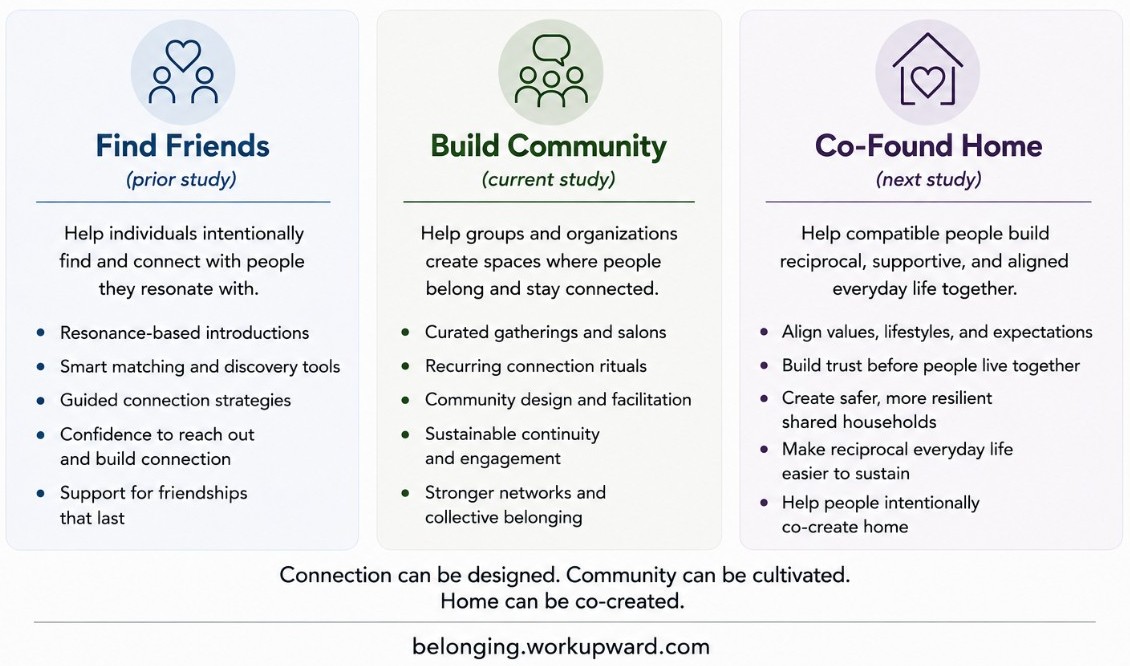
4. Domestic compatibility may require its own design tools.
The experiment also revealed that existing friendship tools are insufficient for the problem I now need to solve:
I need to build a household, but a household isn't simply a friendship with shared rent.
Domestic compatibility requires additional forms of alignment:
- living habits;
- expectations around privacy and shared time;
- parenting approaches;
- attitudes toward children;
- household labor;
- cleanliness;
- noise;
- guests;
- money;
- conflict;
- mutual care;
- employment instability;
- and the degree of interdependence people genuinely want.
Any future search for household members would need to examine compatibility at multiple levels. I'd want clear agreements in advance, including:
- household ground rules;
- defined trial or renewable contract periods;
- notice periods;
- financial responsibilities;
- conflict and exit procedures;
- and an emergency reserve for illness, unemployment, incapacity, or other disruptions.
For a household involving children, I'd likely consider adult compatibility first—personality, values, living style, parenting philosophy, financial reliability, and expectations of shared life—followed by child compatibility and the practical realities of the combined household.
This may eventually become a more general tool or service for others... but for now, it is first a design problem I need to solve for my own life.
5. The next experiment is about home.
The first experiment asked whether belonging could be built.
The answer was yes.
The next question asks whether a viable home can be intentionally co-constructed.
And answering that requires different methods, different safeguards, and a higher standard of evidence.
I expect to continue answering aloud questions that matter not only to myself, but to others, as well -- and, hopefully, in doing so, to contribute to the common good.
10
What comes next
I'm not a person to learn something just to leave it unapplied. What I've reflected here, I plan to put into action already this year.
I intend to move from my current apartment within the next few months and begin co-constructing a domestic life that can anchor the social belonging I've already shown I can build. My goal is to be living in -- or clearly and concretely moving toward -- a new home arrangement already by the end of 2026.
Making that possible will likely include the following actions and timeline:
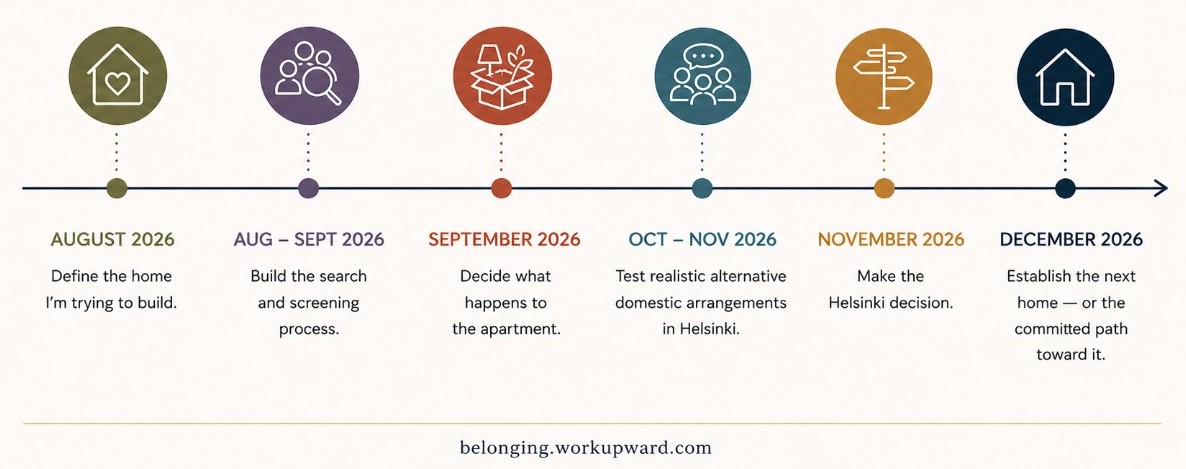
August: Define the home I am trying to build.
In August, I'll turn the idea of “home” -- and my pursuit of it -- into a set of practical specifications.
That means clarifying:
- what I want to share;
- what I need to keep private;
- how much ordinary domestic interaction I want;
- what forms of childcare or practical support may be desired or shared;
- what financial model is sustainable;
- what degree of friendship or emotional closeness is required;
- what is desirable;
- and what is non-negotiable.
I'll also evaluate the realistic models currently available to me, including:
- living with one compatible adult or parent;
- joining an established household;
- being informally “adopted” into an existing family system;
- creating a small co-living arrangement;
- living near trusted people with intentionally shared routines;
- or establishing some other form of a distributed household.
Options exist. Let's see which ones might be best suited and available to me presently.
August–September: Build the search and screening process.
I'll create a structured way to meet the household members I'm seeking and to evaluate potential compatibility.
This will likely include:
- a public or semi-private page describing me and the form of life I hope to build;
- a household compatibility screener;
- adult living and parenting profiles;
- expectations for money, care, privacy, guests, food, noise, and shared time;
- references or trusted-network introductions;
- multiple conversations;
- child introductions only after adult compatibility appears promising;
- and a trial period before any long-term commitment.
My goal wouldn't be to find a high number of applicants necessarily, but rather to identify a very small number of safe and credible possibilities.
September: Decide what happens to the apartment.
By September, I'll begin preparing to leave the current flat.
That will include:
- thinning my possessions;
- determining what I genuinely want to carry into the next life;
- assessing the practical and financial implications of selling versus renting;
- and preparing the property for whichever option preserves the best combination of flexibility, stability, and future choice.
The apartment is an asset. It shouldn't be an obligation to remain in a way of living that won't accommodate my growth.
October–November: Test realistic alternative domestic arrangements in Helsinki.
Before concluding that Helsinki itself is unviable, I'll test whether a more reciprocal domestic structure can credibly be created here.
This may involve:
- conversations with potential household members;
- trial shared meals or recurring domestic routines;
- short stays or structured experiments where appropriate;
- investigating suitable larger properties;
- exploring neighboring or distributed-household models;
- and assessing whether the people interested are emotionally, practically, and financially able to follow through.
Success criteria I'll define in September and will likely refine throughout this process.
Autumn: Offer a limited belonging-design pilot.
Alongside this domestic experiment, I'll reserve limited time to help others also apply what I've learned.
The pilot may support people who want to:
- clarify what friendship means to them;
- assess their existing social ecosystem;
- identify viable connection pathways;
- create a custom friendship-building plan;
- receive curated introductions;
- design a small recurring gathering;
- or build a community around a particular form of resonance.
This will not be positioned as a cure for loneliness or a guarantee of friendship, but it can be a practical process for increasing the probability of finding and sustaining relationships that matter.
I expect this work to further inform my existing social experiments (e.g., Wonder, Pitch a Pal, Rooted, etc.) as well as any future tools I build around friendship and belonging.
November: Make the Helsinki decision.
By this point, I should have evidence regarding:
- whether compatible household possibilities exist here;
- whether those possibilities are materially viable;
- whether my professional structure is improving;
- whether the arrangement would support my daughter;
- and whether the arrangement improves overall locational viability rather than solving only the domestic deficit.
If a credible home can be built in Helsinki, I'll proceed with co-constructing it. If the available options remain hypothetical, fragile, financially impossible, or dependent on my disproportionate effort, I'll select my next test location and will begin an active relocation process to it.
By the winter holidays: Establish the next home—or the committed path toward it.
My goal is to be co-building a home by the end of the year.
That may mean I am already living in a new arrangement or that the property, household, agreements, and move are firmly underway.
But by the end of year, I won't still be sitting in the same apartment, thinking about whether change might be necessary someday; I already know today that it is.
The next experiments will help me design and execute the needed change responsibly.
11
Conclusion
The question that motivated this experiment was straightforward: Should I remain in Finland?
After a summer of structured observation, quantitative tracking, qualitative field notes, and subsequent reflection, I believe the more accurate conclusion is that I was asking the wrong question.
The central issue was not whether I could build social belonging in Finland; the evidence clearly suggests that I can. What it does not establish, however, is that Finland currently supports an overall viable life for me across all the dimensions examined in this study.
Across the month, I demonstrated that I can intentionally build meaningful friendships, establish recurring community, create social continuity, and generate environments in which both I and others experience genuine connection. These findings are encouraging both personally and professionally, and they challenge the common assumption that meaningful adult friendships and belonging cannot be intentionally cultivated.
However, the experiment also identified a structural deficit that these successes did not resolve:
Community proved necessary, but insufficient.
Overall locational viability for me depends not only on social belonging and community participation, but also on professional sustainability and a domestic life that provides ongoing care, shared responsibility, and social companionship. While several of these dimensions scored well, my current domestic arrangement and professional reality remained persistently misaligned with the life I ultimately wish to build.
The primary conclusion of this study, therefore, is not about Finland and barely about belonging -- and more that the current structure of my life is no longer adequate.
Accordingly, I have decided not to preserve the status quo. Instead, I will redesign the domestic structure of my life, evaluate whether a more shared and sustainable form of home can realistically be built in Helsinki, and compare that possibility against alternative locations before making a final geographical decision.
In that sense, the original question remains open—but it has become substantially narrower. The question is no longer whether I can belong here.
The remaining question is whether I can build a home here.
And that is the experiment that follows.

Published 8/5/2026